
The Centre has appointed two directors and a joint director to the National Testing Agency (NTA) amidst ongoing reforms and scrutiny over issues like the NEET paper leak. These appointments are part of a broader overhaul of the NTA's examination system.

Prime Minister Narendra Modi has announced the formation of a high-powered task force, led by Infosys co-founder Nandan Nilekani, to recommend reforms for examinations conducted by the National Testing Agency (NTA). The task force aims to leverage technology for a robust and transparent examination system, following recent public agitation and the resignation of the Education Minister.

Union Minister Jitendra Singh refuted Rahul Gandhi's allegations in Lok Sabha that Home Minister Amit Shah ordered firing on students protesting the NEET fiasco. Singh clarified that no bullets were fired, only tear gas was used, and the authority to order firing rests with a magistrate, not a minister. He also dismissed Gandhi's claims about Shah's cavalcade and foreign travel, criticising the opposition leader for making unsubstantiated remarks during a heated parliamentary debate.

The Congress party, through Deputy Leader Gaurav Gogoi, has criticised the proposed amendments to India's anti-paper leaks law, arguing that previous legislation has failed to prevent examination leaks. Gogoi highlighted the ongoing student protests and questioned the government's sincerity, particularly regarding the handling of the NEET fiasco and the welcome given to former Education Minister Dharmendra Pradhan. He also raised concerns about the National Testing Agency's accountability.

Prime Minister Narendra Modi has affirmed strong action against NEET paper leak culprits and urged state governments to collaborate with the Centre to prevent future incidents, emphasising national interest over party politics. He highlighted the successful re-examination and arrests made.

After six days of stalemate, a discussion on the anti-paper leak bill began on Tuesday in Lok Sabha with the government describing it as a reaffirmation of ruling dispensation's commitment to safeguard the welfare of students but opposition hit back over the lathi-charge on protesters, saying every blow on them hurt the government's prestige more than the backs of the youth.

The Lok Sabha stalemate is expected to conclude as Speaker Om Birla has secured an agreement from all political parties to discuss the Public Examination (Prevention of Unfair Means) Amendment Bill 2026. This bill proposes stricter punishments, including up to 10 years in jail and a Rs 50 lakh fine, for paper leak offences, following recent nationwide student protests over the NEET fiasco.
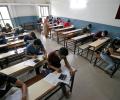
A fresh examination shall be conducted, for which information shall be shared separately, a senior Ministry of Education (MoE) official said.

Mumbai witnessed a second consecutive day of protests by Opposition parties and residents, demanding the resignation of Union Education Minister Dharmendra Pradhan over the NEET fiasco and condemning the police crackdown on a CJP-led march in Delhi.

Amidst widespread student protests over the NEET paper leak, the Indian government has introduced the Public Examinations (Prevention of Unfair Means) Amendment Bill, 2026, in the Lok Sabha. The bill proposes significantly stricter punishments, including jail terms of up to 10 years and fines of up to Rs 50 lakh for individuals involved in paper leaks, and up to Rs 10 crore for organised crimes, aiming to enhance transparency and fairness in public examinations.

Opposition parties, particularly the Congress, have strongly criticised the BJP for felicitating former Union Education Minister Dharmendra Pradhan, who resigned following student protests over the NEET exam controversy. They have also dismissed the government's proposed anti-paper leak legislation as a 'cosmetic Bill' and questioned the sincerity of education reforms.

Voters who exercise their franchise in favour of a particular political dispensation do not do so unconditionally. Their loyalty is subject to maintaining trust and living up to their expectations. It is subject to allowing the freedoms guaranteed under the Constitution, points out Vice Admiral Biswajit Dasgupta (retd).

As Sonam Wangchuk's hunger strike enters its 19th day, critics question why the government has remained silent despite mounting concerns over student welfare, observes Harishchandra.

A social media post by BJP MP Aparajita Sarangi's daughter celebrating Dharmendra Pradhan's resignation as Union Education Minister, has ignited an internal controversy within the BJP.

A wellspring fuelling the CJP tsunami is the high levels of youth unemployment. Millions of youngsters, including extremely over-qualified people, apply in desperation for any job that is advertised. No government has been able to deliver on this front and things may get worse as artificial intelligence enters the workforce, points out Devangshu Datta.

The chairman and secretary of the Central Board of Secondary Education (CBSE) have been removed from their positions following allegations of irregularities in the digital evaluation system for the class 12 examination process.

Prime Minister Narendra Modi lauded young Indian innovators for the country's first privately developed orbital rocket, Skyroot Aerospace's Vikram-1, which made India the third nation with private orbital launch capabilities. While praising the 28-year-old average age of the Skyroot team, Modi made a veiled remark about a "56-year-old young man," widely understood to be a dig at Congress leader Rahul Gandhi, who recently turned 56.

'The software vendor had a black mark against him and yet they went ahead with him. Why was this company shortlisted? Who is responsible for signing off this software?'

'After more than 12 years in power, he has been forced to retreat under public pressure. The education minister's resignation is the biggest political climbdown of his government so far.'

'While not everyone may be pleased with a NEET retest judgment, it would restore fairness and integrity to the process, giving all students an equal opportunity based on merit.' 'This decision would correct the injustices faced by deserving students who were disadvantaged by the initial compromised exam'

Ishan Sardesai, who took the country's first NEET-UG on May 5, 2013 narrates the chaos he went through while appearing for the common medical entrance examination.
